All lovers of Missoula’s natural areas should thank Biking Botanist John Pierce. John was born in Missoula, lived in Montana and Idaho, learning from the land and his father, a US Forest Service forester and UM professor. John graduated from Sentinel High School, spent some semesters at UM working in the herbarium, then served in Viet Nam on a small Navy watercraft, photographing streamside vegetation during combat lulls. On returning to Montana, he studied horticulture and agriculture at MSU, worked in a Billings greenhouse, operated a Big Fork floral shop, and returned to Missoula where he inventoried the flora of the Rattlesnake wilderness as a volunteer. He then earned an MS in Botany at UM, studying changes in the flora of the Big Hole Battlefield since Chief Joseph’s time. In 1983 he began his career as a contract botanist—primarily with the Forest Service and has worked on Research Natural Areas, sensitive plant species’ lists, native plant guides and computerized plant keys. He is said to have swum most of Montana’s lakes, studying aquatic plants.
With passage of its first open space bond in 1980, Missoula began acquiring land for a park along the Clark Fork River’s south side. One of the first parcels protected was ten acres of industrial land between Higgins Avenue and Madison Street. For millennia, Indigenous people harvested bitterroots there. After European settlement, the area became an industrial corridor with railroad yard, oil depot and a tombstone company. The city’s bond was only enough to buy the area, not restore it. Hellgate High School raised funds to convert part of the area to a practice field. The remaining 2.5 acres became Clark Fork Native Prairie. The goal was to recreate the native plant communities in the valley when Lewis and Clark visited in 1806.
In 1990, after two failed attempts to establish native vegetation, the Missoula Conservation Committee asked John Pierce for help. For John, it was the beginning of a 36-year commitment that continues today. With no money and a few volunteers, John faced a herculean task. Native plants had to be found, transported, transplanted, and cared for until established. Some plants were donated, but most were salvaged from developing parts of the valley. Some sites were suggested by friends, but more often, John biked around the valley seeking “For Sale” signs. When he found one, he phoned the landowner. Could he remove the native plants before the bulldozers arrived? Often the answer was “yes.” These ‘Fescue Rescues’ were done by volunteers led by John, donating thousands of hours.
With its 90+ species of plants blooming over the growing season, the Prairie is a valuable outdoor classroom for UM, local schools, and Montana Natural History Center classes for master naturalists, nature artists, and nature lovers.
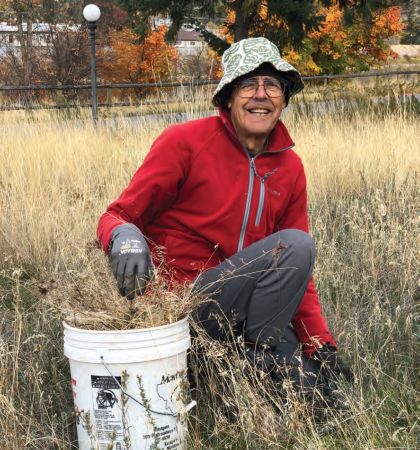
The Prairie still needs volunteers. Weeds continue to invade and must be hand pulled. Inspired by John’s years of caring for the prairie, a Prairie Keepers group has formed to work with Missoula Conservation Lands to carry on his legacy.
John chaired the Greenough Park Advisory Committee 2005-2009 and worked to reduce nonnative plants in Greenough Park, Mount Jumbo and Sentinel. Although his impact on our natural areas is landscape scale, he was honored by having a tiny diatom named for him (Navicula piercei). In 1998 he received the first Burk/Brandborg Award from Missoula Conservation Roundtable.
Contributors – Anne Greene, Scott Miles, Tarn Ream, Kelly Chadwick, Vicki Watson